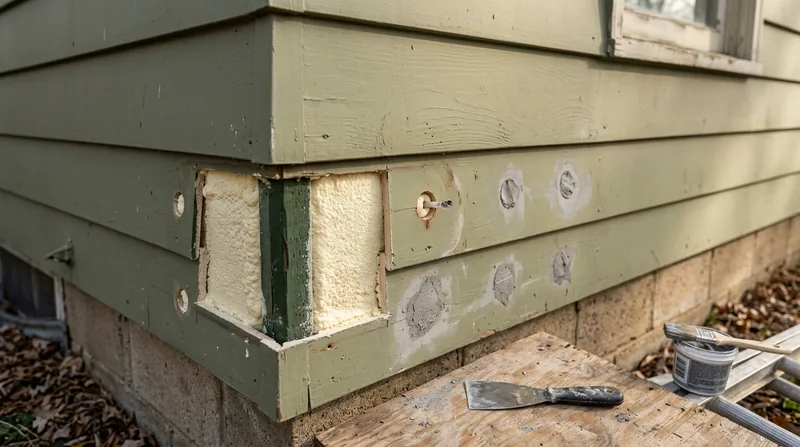




La Crosse sits wedged between Grandad Bluff and the Mississippi River, and that geography shapes the housing stock. Below the bluffs and near downtown, balloon-framed homes from the early 1900s keep full basements and tight wall cavities that chill fast once winter sets in. Mid-century ranches and bungalows fill the rest of the city and spill into Vernon and Monroe county towns. Many of these older homes were never insulated inside the walls, or the insulation that was installed decades ago has settled or failed. Wall and injection foam insulation fills those closed cavities without opening the drywall, restoring warmth and air-sealing the envelope in one step. Small holes are drilled, foam is pumped in, and patches are finished to match existing siding or plaster. For La Crosse homeowners with cold interior walls and heating bills that climb through a long Wisconsin winter, injection foam is a practical retrofit that works.
Why Wall and Injection Foam Insulation Matters in La Crosse's Older Homes
The wall cavities in pre-1980 La Crosse homes were often left empty or filled with materials that have degraded over fifty years. Fiberglass batts settle and compress, leaving air gaps at the top and bottom. Loose-fill cellulose absorbs moisture and clumps. Mineral wool can shift and leave voids. The result is a wall that looks insulated but performs like plywood on a cold January night. Injection foam solves this without demolition: it expands to fill the entire cavity, seals air leaks at the same time, and stays in place for the life of the home.
- We drill small access holes (typically 1 to 1.5 inches) through the exterior siding or interior plaster at regular intervals along the wall cavity.
- Closed-cell or open-cell foam is pumped in under pressure, expanding to fill the cavity completely and seal all gaps and cracks.
- Holes are patched and finished to match the existing exterior or interior surface, leaving no visible damage.
- The wall gains R-value (typically R-5 to R-7 per inch for closed cell, R-3.5 to R-4 per inch for open cell) and air-sealing performance in one application.
Injection foam is the only retrofit method that reaches into a closed cavity without opening it, making it the practical choice for homeowners who want to avoid drywall or siding demolition.
Local example: A 1960s ranch in Holmen with balloon-framed walls and original fiberglass that has settled into the bottom 12 inches of each stud cavity. The top half of the wall is nearly empty. Injection foam fills the voids, restores the R-value, and stops cold air from traveling up through the wall into the attic. The exterior siding stays intact. The homeowner avoids a $15,000 re-siding job.
Verify that any contractor working on your home is fully insured and can provide written estimates with R-value and thickness specifications. You can also confirm the contractor's registration status with the Wisconsin Department of Safety and Professional Services before booking.
How We Perform Wall and Injection Foam Insulation in La Crosse
The injection process begins with a site assessment. We identify the wall cavities to be filled, measure their dimensions, and confirm that the existing structure is sound and dry. We then drill access holes, pump foam into each cavity, and monitor the expansion and cure. Once cured, we patch the holes to match the surrounding material. The entire process is clean, controlled, and leaves no interior disturbance.
- We inspect the wall cavity for moisture, settling, or contamination, and we do not proceed if the substrate is wet or compromised.
- Access holes are drilled at intervals along the wall, typically 16 to 24 inches apart, depending on cavity depth and foam type.
- Foam is injected at controlled pressure and drum temperature, monitored to achieve the specified thickness and density.
- Mechanical ventilation runs during application and curing to manage off-gassing and maintain indoor air quality during the 24 to 48 hour re-entry window.
- Holes are patched with exterior-grade sealant, caulk, or matching siding, and interior patches are finished to blend with existing plaster or drywall.
The work is methodical and requires no demolition, making it the fastest retrofit option for occupied homes.
Example from West Salem: A 1950s bungalow with 2x4 exterior walls and no interior insulation. The homeowner wants to improve winter comfort without opening the walls. We drill access holes through the brick exterior at 24-inch intervals, inject closed-cell foam to R-21, and patch the holes flush with the mortar. The exterior is undisturbed. The interior walls warm up noticeably within a week. See our closed-cell spray foam page for R-value and performance details.
Wall and Injection Foam Insulation Methods
| Method | Description | Best for |
|---|---|---|
| Closed-Cell Injection | Dense foam at R-5 to R-7 per inch, moisture-resistant, structural rigidity, higher cost per board foot. | Exterior walls in cold climates, basements below grade, areas prone to moisture or condensation. |
| Open-Cell Injection | Lighter foam at R-3.5 to R-4 per inch, permeable to vapor, lower cost, good sound dampening. | Interior walls above grade, interior retrofit where cost is a priority, sound control in shared walls. |
| Low-Pressure Injection | Reduced force application, minimizes stress on existing framing, slower fill rate, suitable for older or fragile walls. | Balloon-framed homes, plaster walls, historic structures where pressure must be controlled. |
| Cavity-by-Cavity Fill | Each stud cavity is drilled and filled individually, ensuring complete coverage and no voids between studs. | Retrofit of specific wall sections, partial insulation upgrades, walls with obstructions or bridging. |
Wall and Injection Foam Insulation Cost in La Crosse: What to Expect
Wall and injection foam insulation in La Crosse typically starts at $2 per square foot of wall area, depending on cavity depth, foam type, and access. A 1,000 square foot wall retrofit (for example, a full exterior wall of a two-story home) can range from $2,000 to $4,000 or more if closed-cell foam is specified or if the wall requires extra preparation. The cost varies because deeper cavities hold more foam, and closed-cell costs more per board foot than open-cell. Getting 2 to 3 written estimates with R-value and thickness specifications is the best way to compare value.
- Wall area and cavity depth are the primary cost drivers, since more foam volume means higher material cost.
- Foam type (closed-cell vs. open-cell) affects price significantly, with closed-cell commanding a premium for moisture resistance and R-value density.
- Access and drilling difficulty increase cost if the wall is brick, stone, or difficult to reach from outside or inside.
- Patching material and finish (exterior caulk, siding repair, interior plaster matching) adds labor and material cost.
Our written estimates include R-value per inch, total board feet, thickness, and a clear breakdown of material and labor. See our full pricing page for service-by-service ranges and factors that affect the final quote.
Wall and Injection Foam Insulation Near Me: What La Crosse Homeowners Should Know When Hiring
Choosing a spray foam contractor is a decision that affects your home's comfort, energy performance, and indoor air quality for decades. A few key steps help you hire the right contractor and avoid common pitfalls. First, verify that the contractor is fully insured and can provide proof of coverage. Second, ask for written estimates that include R-value per inch, total thickness, and board footage so you can compare apples to apples. Third, ask about the re-entry window and ventilation protocol during cure. A contractor who promises immediate re-entry or skips mechanical ventilation is cutting corners and should be passed over.
- Request written estimates with R-value, thickness in inches, and board-foot volume so you understand exactly what you are paying for.
- Ask whether the contractor carries full insurance and request a certificate of insurance naming you as an additional insured.
- Confirm that the contractor will use mechanical ventilation during application and cure, and will specify a re-entry window of 24 to 48 hours.
- Check references from recent jobs in La Crosse, Onalaska, or Holmen, and ask about the quality of patching and how well the retrofit performed through the first winter.
- Verify that the contractor will inspect the wall cavity for moisture before proceeding, and will walk away if the substrate is wet or contaminated.
- Ask whether permits are required for your wall retrofit and whether the contractor will help you navigate what applies at your address, since permit requirements vary by city and building official.
A contractor who is transparent about insurance, provides detailed estimates, and explains the cure process and re-entry window is the one to trust. Contact us at (608) 668-4765 for a free estimate, and we will walk you through the process and answer all your questions.
Wall & Injection Foam Insulation in La Crosse: Pricing Guide
| Service | Price | Details |
|---|---|---|
| Open-Cell Injection Foam | Starting at $2/sq ft | Wall area and cavity depth determine total board feet; open-cell costs less per board foot than closed-cell |
| Closed-Cell Injection Foam | Starting at $3.50/sq ft | Higher R-value density and moisture resistance command premium pricing; deeper cavities require more material |
| Multi-Wall or Full-Home Retrofit | On estimate | Large projects benefit from volume pricing; site visit confirms cavity access, depth, and any preparation needed |
| Patching and Finish | Included | Exterior caulk, siding repair, or interior plaster matching is factored into the wall area estimate |
| Travel | Included | No separate fee for service calls in La Crosse, Onalaska, Holmen, West Salem, and surrounding areas |
| Free Estimate | No obligation | Written quote with R-value, thickness, and board footage delivered within 24 hours of phone call |
Indicative pricing, the exact cost depends on square footage, finish, and site access. Free personalized estimate within 24h at (608) 668-4765.


