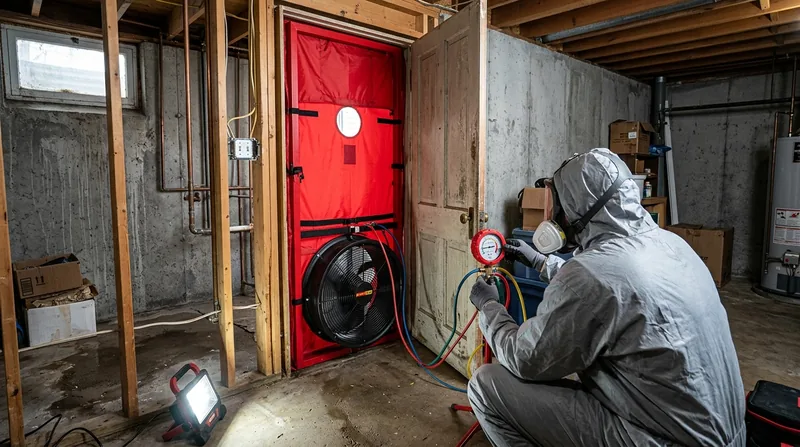




Air sealing in La Crosse targets the gaps that let winter drafts and summer humidity move freely through your walls, attics and rim joists. The Coulee Region's geography, squeezed between Grandad Bluff and the Mississippi River, means most La Crosse homes sit in a high-humidity valley where seasonal air pressure reversals work against tight building envelopes. Winter brings dry furnace air that pulls moisture out of walls; summer brings humid river air that pushes it back in. The rim joists of older downtown homes, the flattened attic insulation in mid-century bungalows, and the cold basement edges in newer subdivisions all leak air year-round. Sealing those gaps with spray foam cuts drafts, reduces the stack effect that pulls cold air up through your home, and stops the seasonal moisture swing that leads to condensation and mold risk. We focus on the high-impact zones: rim and band joists, top plates, rim board penetrations, and attic edges where ice damming starts. A properly sealed home holds temperature longer and costs less to heat through a long Wisconsin winter.
Why Air Sealing Matters in La Crosse's Cold Climate
La Crosse winters demand tight building shells. Homes here lose heat fastest through rim joists, the band of framing between basement and first-floor walls, and through attic edges where warm air rises and escapes. The stack effect, warm air rising out of the living space, pulls cold air in from the basement and crawl space, and that pressure difference accelerates every draft. Humidity compounds the problem: winter furnace air dries out interior walls, then summer humidity reverses the vapor drive, pushing moisture back inward where it condenses on cold rim joists and basement band boards. Sealing these zones with closed-cell or open-cell foam stops both the air movement and the vapor exchange that causes the problem.
- We seal rim joists and band boards to stop basement cold air from entering the living space.
- We target top plates and attic edges to cut the stack effect that pulls warm air out of the home.
- We seal penetrations around pipes, electrical chases and HVAC ducts where air leaks concentrate.
- We use spray foam to fill irregular cavities that blown-in or fiberglass cannot seal completely.
Airtight sealing reduces heating load and prevents the condensation risk that leads to structural damage in a climate where winter-to-summer humidity swings are extreme.
Key info: La Crosse building codes require mechanical ventilation during spray foam cure and a stated re-entry window. Your local building department sets the thermal barrier and ignition barrier rules. We help you navigate what applies at your address, and we defer to the official code adopted by your city. See La Crosse building and safety for your specific requirements.
How We Seal Air Leaks in La Crosse Homes
Air sealing starts with identifying where air moves. We inspect rim joists, top plates, attic band boards, and penetrations for gaps and cracks. Once we map the leak points, we clean the substrate, set up mechanical ventilation to manage fumes during cure, and spray closed-cell or open-cell foam to fill voids and seal cracks. Closed-cell foam (R-6 to R-8 per inch) works best for rim joists and rim boards in basements where moisture risk is high; open-cell foam (R-3.5 per inch) is cost-effective for attic top plates and band boards where vapor permeability is an advantage. We apply foam to the specified thickness, allow proper cure time (typically 24 to 48 hours before re-entry), and leave the home with a sealed, continuous air barrier that stops drafts and controls vapor drive.
- We inspect the home to locate air leaks at rim joists, penetrations, top plates and attic edges.
- We clean and prep the substrate to ensure foam bonds fully and cures without voids.
- We set up mechanical ventilation and establish a re-entry window before any occupant returns.
- We apply spray foam at the manufacturer ratio and temperature to guarantee proper density and R-value.
- We provide written documentation of the foam type, thickness, R-value and coverage area for your records.
This methodical approach ensures the air seal holds through seasonal pressure and humidity swings without surprises after the job is done.
Local example: A 1970s ranch in West Salem with a full basement and original fiberglass in the rim joist cavity typically shows air leakage at the rim board and top plate where the basement wall meets the first-floor framing. We seal the rim board with closed-cell foam (typically 1.5 to 2 inches), then seal the top plate and band board above with open-cell foam to allow the wall to breathe. The cost depends on the linear footage of rim and the height of the band board, but a typical West Salem ranch rim joist sealing runs between $1,200 and $2,000.
Air Sealing Methods and When to Use Each
| Approach | Description | Best for |
|---|---|---|
| Closed-cell spray foam | High-density foam at R-6 to R-8 per inch, forms a vapor barrier, resists moisture penetration. | Rim joists, basement band boards, crawl spaces, areas where moisture risk is high. |
| Open-cell spray foam | Lower-density foam at R-3.5 per inch, breathable, allows vapor transmission, lighter cost per board foot. | Attic top plates, band boards above grade, interior walls where vapor permeability is an asset. |
| Injection foam | Low-pressure foam injected into existing wall cavities without demolition, fills closed stud bays. | Balloon-framed walls in older downtown La Crosse homes, retrofit insulation without wall tear-out. |
| Caulk and sealant (non-foam) | Polyurethane caulk or silicone sealant for small cracks, seams and penetrations under 1 inch wide. | Electrical outlets, pipe penetrations, trim gaps, supplemental sealing after foam application. |
The choice between closed-cell and open-cell depends on the location, moisture risk, and your budget. Closed-cell is the premium choice for basements and rim joists; open-cell is cost-effective for attics and band boards above grade. We specify the right foam for each zone and document the thickness and R-value so you have a record of what was installed.
Air Sealing Cost in La Crosse: What to Expect
Air sealing costs depend on the square footage of rim board, the linear feet of top plate and band board, the number and size of penetrations, and the foam type you choose. A typical rim joist sealing in a La Crosse basement starts at $650 for a small, accessible space and can run $1,500 to $3,000 for a full basement perimeter with multiple penetrations. Attic top plate and band board sealing typically costs $400 to $1,200 depending on the attic size and accessibility. Injection foam for closed wall cavities in older downtown homes runs $800 to $2,500 per wall section, again based on the cavity size and the number of injection points needed.
The factors that move the price are linear footage of rim and band board, the height of the cavity to be sealed, accessibility (tight crawl spaces or attics cost more), the foam type (closed-cell is more expensive than open-cell), and the number of penetrations that need individual attention. We provide a written estimate with R-value and thickness specs so you know exactly what you are paying for. Visit our pricing page for a full breakdown by service type, or call us at (608) 668-4765 for a free, no-obligation estimate.
Getting 2 to 3 estimates from different contractors is smart. A reputable estimator will spend time on site, measure the space, identify all leak points, and give you a detailed scope and price. Avoid estimates with no R-value or thickness specification, no mention of mechanical ventilation during cure, or prices far below market: these are signs of poor workmanship or hidden costs later.
What to Look for When Hiring an Air Sealing Contractor Near Me in La Crosse
The spray foam industry includes rig-and-run crews from out of state (trailer in, job sprayed in an afternoon, nobody reachable when the smell lingers) and national franchises that subcontract to local crews. A local independent contractor with a local address and local plates is your best bet. Verify that the contractor is fully insured and can provide a certificate of insurance on request. Ask for references from recent jobs in La Crosse, Onalaska or Holmen, and call them to ask about the quality of the seal, the cure time, and whether any odor issues arose after re-entry. Check that the contractor understands local building code requirements for thermal barriers, ignition barriers and mechanical ventilation; if they cannot name the specific code adopted by your city, that is a red flag.
- Verify the contractor is fully insured and can provide proof of coverage before work begins.
- Request a written estimate with R-value, thickness, foam type and coverage area clearly stated.
- Ask for references from recent jobs in La Crosse and call them to confirm quality and satisfaction.
- Confirm the contractor understands your local building code and will help you navigate permitting if required.
- Ask about mechanical ventilation during cure and the stated re-entry window, typically 24 to 48 hours.
- Avoid contractors who promise immediate re-entry, offer prices far below market, or cannot explain the thermal barrier requirement.
A contractor who takes time to understand your home, provides a detailed written estimate, and explains the cure process and re-entry timeline is one you can trust to do the job right. Contact us for a free estimate and a chance to ask questions before you decide.
Air Sealing in La Crosse: Pricing Guide
| Service | Price | Details |
|---|---|---|
| Rim joist and band board sealing | Starting at $650 | Includes closed-cell foam application to basement rim and band board, linear footage and cavity height drive the final cost |
| Attic top plate and band board sealing | Starting at $400 | Open-cell or closed-cell foam applied to attic band boards and top plates, cost scales with attic perimeter and access difficulty |
| Injection foam for closed wall cavities | Starting at $800 | Low-pressure foam injected into existing walls without demolition, price depends on cavity size and number of injection points needed |
| Full-home air sealing (rim, attic, penetrations) | On estimate | Comprehensive sealing of rim joists, attic edges and all major penetrations requires an on-site inspection to establish scope and price |
| Travel | Included | No separate mileage fee or travel charge within La Crosse and surrounding service areas |
| Free written estimate | No charge | Detailed quote with R-value and thickness specs provided within 24 hours, no obligation to book, call (608) 668-4765 |
Indicative pricing, the exact cost depends on square footage, finish, and site access. Free personalized estimate within 24h at (608) 668-4765.


