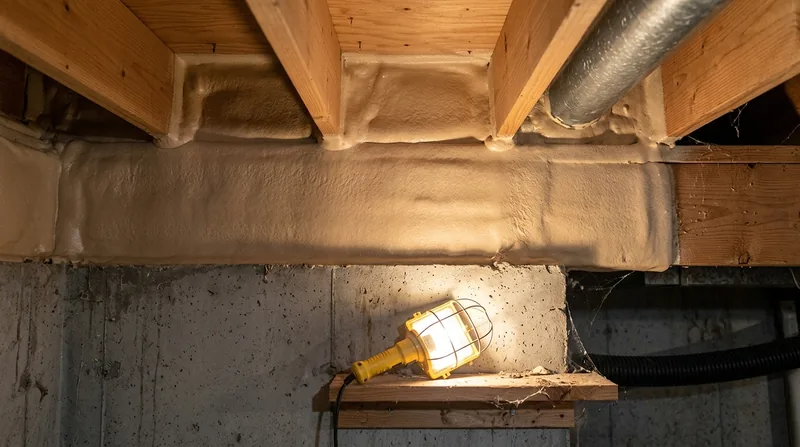




La Crosse sits wedged between Grandad Bluff and the Mississippi River, where humid summers and long frozen winters create a perfect storm for condensation damage. The city's older balloon-framed homes, mid-century ranches, and newer subdivisions all face the same moisture challenge: warm, wet river-valley air in summer pushes into cold walls and attics, while dry winter heating pulls moisture back the other direction. Closed cell spray foam insulation in La Crosse blocks that moisture drive with a rigid, vapor-impermeable barrier, protecting rim joists, crawl spaces, and cathedral ceilings where condensation risk runs highest. This is the insulation choice for homes that can't afford seasonal moisture damage, ice dams, or mold creep into wall cavities. We spray it right, measure it thick, and walk away when the substrate is dry.
Why Closed Cell Foam Matters in La Crosse's Climate
The Coulee Region's geography and weather create insulation challenges that fiberglass and open cell foam alone cannot solve. Winter heating dries indoor air to 20 percent humidity, then summer river air soaks in at 70 percent or higher, reversing the vapor drive through your walls twice a year. Rim joists, band joists, and attic edges where cold meets warm are the first places condensation forms. Crawl spaces under older homes collect standing moisture from the earth and from humid summer air. Closed cell foam stops that moisture at the source, blocking both air and vapor, and it adds rigidity to walls and ceilings that need structural reinforcement.
- We spray closed cell foam in rim and band joists to seal the gap between foundation and rim board where winter cold and summer humidity meet hardest.
- We seal attic edges and cathedral ceilings with closed cell to prevent ice damming and condensation buildup on roof decks.
- We insulate crawl spaces with closed cell to block ground moisture and warm the floor above during winter heating.
- We inject closed cell into existing wall cavities in pre-1980 homes without tearing out drywall or plaster.
Closed cell foam is the right answer when moisture control and structural support matter more than cost alone.
Key info: A 1950s bungalow in West Salem with a damp crawl space and sagging rim joist gains both insulation and structural stiffening from closed cell spray foam, plus the moisture barrier that stops rot and mold before they start.
For more on how we handle moisture-prone spaces, see our crawl space spray foam insulation and rim joist and band joist spray foam pages.
Wisconsin building codes require that attic ventilation, ignition barriers, and thermal barriers comply with the energy and building code in force at your address. Verify any code-specific requirements with your local building department before work begins. For La Crosse, contact the City of La Crosse Building Inspection Division to confirm what applies to your job.
How We Spray Closed Cell Foam in La Crosse Homes
Closed cell spray foam is applied in thin, controlled passes. Each pass cures to full density and hardness within minutes, and we measure thickness and R-value on site to meet your home's specification. The work is fast, but the prep and cure protocol matter more than speed. We check substrate moisture, ensure mechanical ventilation during application, and enforce a re-entry window of 24 to 48 hours before the space is safe to occupy.
- We inspect the substrate (walls, joists, roof deck, crawl space floor) and verify it is dry and free of active moisture.
- We set up containment and mechanical ventilation to manage fumes and pressure during the spray.
- We apply closed cell foam in controlled passes, building thickness to the specified R-value and depth.
- We measure each section as it cures to confirm R-value, thickness, and coverage against your written estimate.
- We post a re-entry notice and confirm the space is safe before you return.
The result is a vapor barrier and insulation layer that holds its R-value and does not settle, shrink, or degrade over decades.
Example: A two-story home in Holmen with a cathedral ceiling over the master bedroom gets 3 inches of closed cell foam sprayed to the underside of the roof deck, creating an unvented attic with R-18 insulation and a continuous air seal. The homeowner gains a warm, dry ceiling in winter and no moisture condensation in summer.
Learn more about our air sealing services and how they complement spray foam insulation.
Closed Cell Spray Foam Methods and Applications
| Application | How It Works | Best For |
|---|---|---|
| Sealed Roof Deck (Unvented Attic) | Spray closed cell to the underside of the roof sheathing, creating an air-tight, unvented attic that prevents ice damming and keeps attic temperature stable. | Cathedral ceilings, bonus rooms, and homes where attic ventilation is impractical or not code-compliant. |
| Rim and Band Joist Sealing | Fill the cavity between the rim board and rim joist with closed cell foam to block air leakage and moisture infiltration at the foundation line. | Older homes with exposed rim joists, homes with cold floors in winter, and crawl spaces with moisture issues. |
| Crawl Space Insulation | Spray closed cell on crawl space walls and band joists to create a thermal and moisture barrier, preventing ground moisture from rising into the floor above. | Crawl spaces in pre-1980 homes, wet or damp crawl spaces, and homes with cold first floors. |
| Wall Cavity Injection (Retrofit) | Inject closed cell foam into existing wall cavities through small drilled holes, filling cavities without demolition and adding R-value and air sealing to balloon-framed and older walls. | Retrofit insulation in occupied homes, balloon-framed walls, and cavity walls that have settled or failed insulation. |
| Metal Buildings and Barndominiums | Spray closed cell to the underside of metal roof and wall panels to prevent condensation on steel and create a thermal break between the metal and the interior. | Pole barns, agricultural buildings, shops, and barndominiums where condensation on metal is a chronic problem. |
Closed cell foam is denser and more expensive than open cell, but it delivers vapor blocking and structural strength that open cell cannot match. For attics where moisture is not the primary concern, open cell spray foam may be the more cost-effective choice.
Closed Cell Spray Foam Insulation Cost in La Crosse: What to Expect
Closed cell spray foam costs more per board foot than open cell or blown-in fiberglass because of its density, vapor barrier, and structural properties. In La Crosse and the surrounding area, closed cell foam typically starts at $1.20 per board foot, though the final cost depends on job size, access, substrate condition, and the R-value depth you need. A small rim joist job might run $800 to $1,500. A full crawl space or sealed attic can run $3,000 to $8,000 or more. The larger the area, the more efficient the per-board-foot cost becomes.
Factors that move the price up or down include substrate prep (if we need to remove old insulation or repair moisture damage first), access difficulty (tight crawl spaces or multi-story cathedral ceilings take longer), and the thickness required to meet your R-value target. A home in Onalaska with a damp crawl space may need extra ventilation setup or substrate drying before we spray, which adds to the job cost. A newer subdivision home in Holmen with a clean, dry attic and simple geometry will spray faster and cost less per board foot.
Always get two or three written estimates that spell out the R-value, thickness in inches, and total board feet. Estimates should include a site visit, photos, and a clear scope. Avoid any contractor who quotes a price without visiting the site or who promises a firm price before measuring the actual space. For detailed pricing guidance and a free estimate, see our pricing page or call us at (608) 668-4765.
What to Look for When Hiring a Closed Cell Spray Foam Contractor Near Me in La Crosse
Spray foam is not a commodity, and the difference between a careful installation and a careless one shows up months later in odors, performance failure, or moisture damage. When you call a contractor, ask for a site visit and a written estimate with R-value and thickness specified. Verify that the contractor is fully insured and ask for a copy of the insurance certificate. Check references from recent jobs in La Crosse, Onalaska, or Holmen, and ask those homeowners about cure time, smell, and whether the work held up through a full heating and cooling cycle.
- Request a written estimate that names the R-value, thickness in inches, and total board feet to be sprayed, never a price without a site visit.
- Verify that the contractor is fully insured and obtain a copy of the current insurance certificate.
- Ask for references from three recent jobs in your area and contact them to ask about cure time, odor, and long-term performance.
- Confirm that mechanical ventilation will be used during the spray and that a re-entry window of 24 to 48 hours will be enforced.
- Check with your local building department to confirm whether a permit is required for spray foam insulation at your address.
- If your home is in an HOA or a historic district, verify that exterior work or metal building insulation complies with architectural guidelines.
Hiring a spray foam contractor is a bigger decision than hiring a painter or a landscaper. Take time to verify credentials and get multiple estimates. Contact us for a free estimate, and we will walk you through the process and answer any questions about permits, timing, or long-term performance.
Closed Cell Spray Foam Insulation in La Crosse: Pricing Guide
| Service | Price | Details |
|---|---|---|
| Rim and Band Joist Sealing | Starting at $1.20/board ft | Small-ticket entry point, typically 50 to 150 board feet depending on foundation perimeter and joist depth |
| Crawl Space Insulation | Starting at $1.20/board ft | Medium to large job, 200 to 800 board feet, cost scales with square footage and moisture prep requirements |
| Sealed Attic or Cathedral Ceiling | Starting at $1.20/board ft | Largest ticket in the spray foam portfolio, 400 to 2,000 board feet, cost depends on attic size and roof geometry |
| Wall Cavity Injection (Retrofit) | Starting at $1.20/board ft | Retrofit insulation in existing homes, 100 to 500 board feet per wall section, no demolition required |
| Metal Building or Barndominium | On estimate | Large structures with complex geometry and condensation control needs require site measurement and vapor barrier strategy |
| Estimate and Travel | Free | No obligation, response within 24 hours, included in service area of La Crosse and surrounding Vernon and Monroe counties |
Indicative pricing, the exact cost depends on square footage, finish, and site access. Free personalized estimate within 24h at (608) 668-4765.


